

Introduction
Understanding the AC vs DC EV Charger difference is one of the first steps for anyone planning to install EV charging infrastructure — whether for home use, a commercial property, or a fleet depot. Many new EV owners and business buyers confuse the two technologies, leading to wrong equipment purchases, overspending, or charging speeds that fail to meet their needs.
This guide breaks down exactly how the AC vs DC EV Charger technologies work, the key performance gaps between them, real-world charging times, and the ideal use cases for each type. By the end, you will be able to confidently choose the right charging solution for your specific scenario.
Core Basics: How EV Battery Charging Works
All electric vehicle batteries run on direct current (DC) power. However, the power supplied by the public electrical grid is universally alternating current (AC). The core difference between AC and DC charging comes down to where the AC-to-DC power conversion happens: inside the vehicle, or inside the charging station itself.
This single design difference is the foundation of every AC vs DC EV Charger comparison, and creates massive gaps in charging speed, hardware cost, installation requirements, and suitable applications across residential, commercial and public scenarios.
What is an AC Charger?
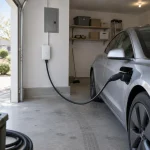
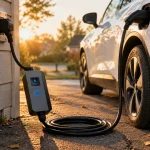
An AC charger (alternating current charger) is the most common type of EV charging equipment, widely used for home parking, office lots and low-traffic commercial locations.
How AC EV Charging Works
With AC charging, the charging station only delivers grid AC power to the vehicle. The actual conversion from AC to DC power happens inside the car’s built-in on-board charger (OBC). The converted DC power then feeds directly into the vehicle’s battery pack.
Because the conversion hardware is built into the car, AC charging stations themselves have a simpler, more compact design and lower production cost.
AC Charging Power Levels: What is Level 2 Charging?
AC charging is categorized into two standard levels defined by SAE International (Society of Automotive Engineers):
- Level 1 AC: 120V household outlet, 1.4–1.9kW power, primarily for emergency home use. A standard EV requires 40–50 hours to fully charge on Level 1.
- Level 2 AC: 240V single-phase or three-phase power, 3.7kW–22kW power, the global standard for home and commercial slow charging.
For most passenger EVs with a 65kWh battery, a 7kW Level 2 charger will fully charge the vehicle in 8–10 hours, while a 22kW commercial Level 2 unit reduces that time to 3–4 hours. Per SAE J1772 standards, Level 2 is the most widely supported AC charging format for all mainstream EV models.
Common Use Cases for AC Chargers
- Residential home overnight charging
- Office parking lots (all-day employee charging)
- Hotel, apartment and retail parking (long dwell time locations)
- Low-cost, high-volume commercial charging deployments
What is a DC Charger?
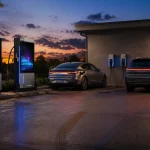
A DC charger (direct current charger), also known as a DC fast charger, is high-power charging equipment designed for rapid battery top-ups.
How DC EV Charging Works
With DC charging, the AC-to-DC power conversion happens inside the charging station itself, not inside the vehicle. The station outputs DC power directly into the EV battery, bypassing the car’s on-board charger.
By moving the conversion to the external station, DC chargers can deliver far higher power levels than AC units, as they are not limited by the size and capacity of a vehicle’s built-in on-board charger. This is the core reason the AC vs DC EV Charger speed gap is so significant.
DC Fast Charging Power Levels
DC chargers are available in a wide range of power ratings for different use cases:
- Entry-level DC fast charging: 30kW–60kW, for urban public charging and small commercial sites
- Standard DC fast charging: 120kW–180kW, the most common configuration for highway rest stops and retail centers
- Ultra-fast DC charging: 250kW–360kW+, for premium highway stations and 800V high-voltage EV platforms
According to the International Energy Agency (IEA), DC fast chargers can deliver an 80% battery top-up in 20–40 minutes for most passenger EVs, compared to multiple hours for AC charging.
Common Use Cases for DC Chargers
- Highway rest stops and intercity travel corridors
- High-traffic retail centers, gas stations and convenience stores
- Fleet depots for delivery vans, taxis and commercial vehicles
- Public charging stations with short driver dwell times
AC vs DC EV Charger: Full Side-by-Side Comparison
The table below summarizes the core technical and operational differences between the two AC vs DC EV Charger categories:
| Comparison Category | AC EV Charger (Level 2) | DC Fast Charger |
| Power conversion location | Inside the vehicle (on-board charger) | Inside the charging station |
| Typical power range | 3.7kW – 22kW | 30kW – 360kW+ |
| Full charge time (65kWh battery) | 3 – 10 hours | 20 – 60 minutes (0-80%) |
| Hardware & installation cost | Low (single unit $500–$3,000) | High (single unit $10,000–$50,000+) |
| Grid power requirement | Low (standard 240V supply) | High (three-phase industrial grid connection) |
| Impact on battery health | Minimal, gentle charging profile | Higher long-term wear with frequent use |
| Typical installation footprint | Compact, wall-mounted or pedestal | Large floor-standing cabinet |
Data sources: IEA Global EV Outlook 2025; SAE International J1772 Charging Standard
Level 2 vs DC Fast Charging: Speed Breakdown
When discussing AC vs DC EV Charger speed, most buyers want a direct comparison of real-world charging times. One of the most common questions from buyers is dc or ac charging faster — and the answer depends entirely on power level and use case.
For context, we compare the time required to charge a standard 65kWh passenger EV battery from 0% to 80%:
- 7kW Level 2 AC charger: ~7.5 hours
- 22kW Level 2 AC charger: ~2.5 hours
- 50kW DC fast charger: ~1 hour
- 150kW DC fast charger: ~25 minutes
- 250kW DC ultra-fast charger: ~15 minutes
While DC charging is dramatically faster, it is important to note that charging speed drops significantly after the battery reaches 80% charge. This is a built-in battery protection feature across all EVs, which is why most public fast charging sessions end at 80% rather than 100%.
For locations where vehicles are parked for 4+ hours (offices, homes, hotels), Level 2 AC charging delivers more than enough speed at a fraction of the cost. For short-stay locations, the AC vs DC EV Charger speed gap makes DC fast charging the only practical option.
Pros and Cons of AC vs DC EV Charging
To make an informed decision, you need to weigh the full set of tradeoffs for each AC vs DC EV Charger type, aligned with your actual usage scenario.
Advantages & Disadvantages of AC Chargers
Advantages
- Low upfront hardware and installation cost
- Simple installation with minimal grid upgrades
- Gentle charging profile that preserves long-term battery health
- Compact size, easy to deploy in large quantities
- Universal compatibility with all EV models on the market
Disadvantages
- Slow charging speed, unsuitable for short-stay locations
- Higher power models are limited by the vehicle’s on-board charger capacity
- Not cost-effective for rapid public charging business models
Advantages & Disadvantages of DC Chargers
Advantages
- Extremely fast charging, enabling 15–30 minute top-ups
- No dependency on the vehicle’s on-board charger capacity
- Enables profitable pay-per-use public charging business models
- Supports commercial fleet operations with tight turnaround schedules
Disadvantages
- Very high hardware and installation costs
- Requires heavy-duty grid infrastructure and electrical upgrades
- Larger physical footprint requires more parking space
- Frequent fast charging can accelerate battery degradation over time
How to Choose the Right Charger for Your Business
Selecting the right AC vs DC EV Charger setup depends entirely on your site, user base and business goals:
- For residential, office, hotel or apartment parking: Choose Level 2 AC chargers. Vehicles are parked for multiple hours, so slow charging is sufficient, and the cost savings are substantial.
- For highway rest stops, gas stations or high-traffic retail: Choose DC fast chargers. Drivers only stay for 15–60 minutes, and fast charging is a core draw for customers.
- For commercial fleet depots: Match the charger type to your schedule. For overnight parking, AC chargers are the most cost-effective. For daytime turnaround routes, DC fast charging is required.
- For mixed-use commercial properties: Deploy a hybrid AC vs DC EV Charger solution — majority Level 2 AC chargers for regular parking, plus 1–2 DC fast chargers for premium or emergency use.
FAQs
Is an AC charger faster than a DC charger?
When comparing AC vs DC EV Charger speeds, a common question is whether an AC charger is faster than a DC charger. The answer is no. DC chargers are universally faster than AC chargers at equivalent use cases. Even an entry-level 50kW DC charger delivers 2–10x the power of a standard Level 2 AC charger. The only exception is ultra-low-power DC units, which are rare in commercial deployment.
Can I use an AC charger for a DC vehicle?
All production EVs support AC charging, regardless of whether they also have DC fast charging capability. The AC charging port is a standard feature on every modern electric vehicle. DC-only vehicles do not exist for consumer or light commercial use.
What is the best option for home charging?
A Level 2 AC charger (7kW is standard for most homes) is the universal best option for home charging. It is affordable, easy to install, and fully charges most EVs overnight while electricity rates are lowest. DC fast charging is never recommended for home use due to extreme cost and grid requirements.
Is there a DC Level 2 charger?
No, “Level 2” is an AC-only classification defined by SAE industry standards, and does not apply to any AC vs DC EV Charger category. DC charging is categorized separately as DC fast charging (DCFC) with no Level 1/Level 2 naming. The term “dc level 2 charger” is a common misnomer from users mixing up the two charging classifications.
Final Takeaways
The core AC vs DC EV Charger distinction ultimately comes down to a tradeoff between speed and cost:
- AC charging is low-cost, reliable and ideal for long-dwell-time locations where vehicles are parked for hours at a time
- DC fast charging delivers rapid top-up speeds but requires significant upfront investment and grid infrastructure
There is no universally “better” AC vs DC EV Charger option — the right choice depends entirely on your site, users and operational goals.
Source Reliable EV Charging Equipment From EVTAURUS
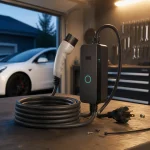
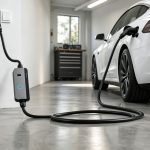
EVTAURUS is a professional manufacturer of EV charging equipment with over 12 years of industry experience and 55 registered technology patents. We supply a full range of commercial ev chargers, including Level 2 AC chargers, high-power DC fast chargers, portable charging boxes, charging cables and adapters, all available with full OEM/ODM customization.
Whether you need a bulk supply of Level 2 units or high-power DC fast chargers, we have every AC vs DC EV Charger configuration covered for commercial projects. Our engineering team can provide tailored hardware solutions and technical support for your project. Contact EVTAURUS today to request product specifications and a custom quotation for your charging infrastructure needs.