

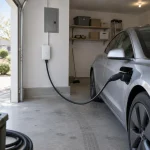
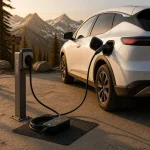
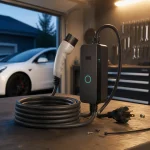
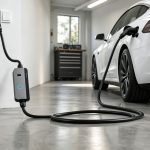
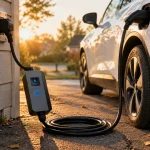
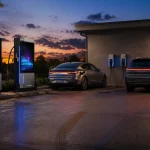
What Is DC Fast Charging (DCFC)?
DC fast charging (short for Direct Current Fast Charging, often abbreviated as DCFC) is the highest-power EV charging technology available for commercial deployment, capable of replenishing most passenger EV batteries to 80% in 20–40 minutes.
Core Working Principles of DC Fast Charging Technology
All EV batteries run on direct current (DC) power, while public electrical grids supply alternating current (AC) power. Unlike AC chargers that rely on the vehicle’s built-in on-board charger (OBC) to complete AC-to-DC conversion, electric vehicle DC fast chargers integrate the conversion hardware directly inside the charging station.
By bypassing the vehicle’s on-board charger, DC fast chargers can deliver far higher power output directly to the battery, drastically reducing charging time. This is the core technical difference that defines DCFC as a fast-charging solution.
DC Fast Charging vs. Level 2 AC Charging: Key Differences for Commercial Use
The table below summarizes the core gaps between the two technologies for commercial applications:
| Comparison Metric | DC Fast Charger | Level 2 AC Charger |
| Power conversion location | Inside the charging station | Inside the vehicle (on-board charger) |
| Typical power range | 50kW – 350kW+ | 3.7kW – 22kW |
| 0-80% charge time (65kWh battery) | 20 – 60 minutes | 3 – 10 hours |
| Upfront hardware & installation cost | High | Low |
| Grid capacity requirement | High (three-phase industrial supply) | Low (standard 240V supply) |
| Ideal commercial scenario | Short-stay public charging, highway rest stops | Long-dwell parking, offices, hotels |
Common Commercial DCFC Power Ratings & Use Cases
Commercial DC EV Chargers are available in standardized power tiers, each designed for specific deployment scenarios:
- 50kW entry-level DCFC: Entry-level public charging, urban community stations, small retail sites; suitable for 1–2 hour dwell time locations
- 120kW standard DCFC: Most common configuration for highway rest stops, mid-sized retail centers; delivers 200–300km of range in 30 minutes
- 180kW high-power DCFC: High-traffic commercial charging stations, flagship retail locations; supports 800V EV platforms for faster charging
- 350kW+ ultra-fast DCFC: Premium highway corridors, fuel station networks; delivers 300+ km of range in 10–15 minutes for high-voltage EV models
Types & Global Charging Standards of DC Fast Chargers
Overview of Global Mainstream DCFC Charging Standards
Different regions have adopted distinct DC charging connector standards, and selecting the correct standard is critical for market-specific deployment. According to the International Council on Clean Transportation (ICCT), four standards dominate the global commercial CCS DC fast charger market.
CCS (Combined Charging System): The Dominant Standard for Global Commercial Deployment
CCS (Combined Charging System) is the most widely adopted global DC charging standard, split into CCS1 (North America) and CCS2 (Europe, Oceania, most emerging markets). It supports both AC and DC charging through a unified connector design, and is the default standard for nearly all non-Chinese, non-Japanese EV brands.
Per ICCT 2024 data, CCS standards account for over 70% of public DC fast charging ports outside of China, making it the safest choice for cross-market commercial deployment.
Regional Standard Comparison: Tesla NACS, CHAdeMO & GB/T
| Standard | Dominant Region | Core Features | Market Position |
| Tesla NACS | North America | Compact design, supports up to 1MW DC charging | Rapidly growing in North America; adopted by Ford, GM, Hyundai and other mainstream brands |
| CHAdeMO | Japan, select Southeast Asian markets | First mass-market DC standard, supports V2G | Declining global share; still standard for Japanese-brand EVs |
| GB/T DC | Mainland China | National mandatory standard, high-power 1000V+ support | Dominates the world’s largest EV market (China) |
Data source: International Council on Clean Transportation (ICCT) Global EV Charging Monitor 2024
How to Choose Charging Standards for Your Target Regional Market
- Europe, Middle East, Oceania: Prioritize CCS2 as the default configuration
- North America: Offer CCS1 + NACS dual-gun options to cover all vehicle models
- Japanese & select Southeast Asian markets: Add CHAdeMO compatibility alongside CCS
- Chinese domestic market: Use GB/T DC as the mandatory standard
Core Business Benefits of Deploying DC Fast Chargers
Ultra-Fast Charging Speed & Operational Efficiency Improvement
The most direct advantage of DC fast chargers is drastically reduced per-vehicle charging time. For commercial charging station operators, this means higher daily throughput per charging bay, more paid sessions per day, and faster return on investment compared to slow AC charging infrastructure.
New Revenue Streams for Commercial Property & Station Operators
Beyond per-kWh charging revenue, DC fast charging stations can generate ancillary income: on-screen advertising, parking surcharges, premium fast-charging tier pricing, and partner promotions. For property owners, adding DCFC infrastructure also increases overall property value and rental appeal.
Increased Foot Traffic & Customer Retention for Retail & Hospitality
EV drivers actively seek out destinations with DC fast charging. According to industry surveys, 68% of EV drivers will choose a retail center, restaurant or hotel with on-site fast charging over a competing location without charging facilities. Longer charging dwell times also translate directly to higher in-store spending for retail and hospitality businesses.
Lower Operational Costs for Enterprise Fleet Electrification
For logistics, delivery and corporate fleets, ev DC fast chargers enable mid-shift top-up charging, reducing the number of reserve vehicles needed and improving fleet utilization. Scheduled fast charging can also be paired with off-peak electricity tariffs to control total energy costs.
ESG Compliance & Alignment with Local Emission Reduction Policies
Deploying DC fast charging infrastructure helps businesses meet corporate ESG targets, comply with local zero-emission regulations, and qualify for government green infrastructure grants and tax incentives across most global markets.
Step-by-Step Guide to Choosing the Right DC Fast Charger for Your Business
Step 1: Assess Site-Specific Requirements
First, define your core user profile (public drivers, fleet vehicles, retail customers), available parking layout, and existing site electrical grid capacity. These factors will determine the maximum power level and number of chargers you can deploy.
Step 2: Evaluate Charger Power Capacity & Configuration
Match power rating to average driver dwell time:
- 30+ minute dwell time (retail, urban stations): 50–120kW is sufficient
- 15–30 minute dwell time (highway rest stops, fuel stations): 150–180kW is recommended
- Premium high-turnover locations: 250kW+ ultra-fast chargers For high-traffic sites, dual-gun DC fast chargers can double throughput per unit without extra grid infrastructure.
Step 3: Compatibility With Existing Grid & Energy Infrastructure
Confirm your site’s available grid capacity and utility approval requirements. For sites with limited grid capacity, consider pairing DC fast chargers with battery energy storage systems to avoid costly transformer upgrades.
Step 4: Smart Charging Management & Network Connectivity Features
Prioritize chargers with OCPP 1.6J/2.0 compliance, which supports integration with all major charging management systems (CMS) for remote monitoring, billing, firmware updates and load balancing. Look for Ethernet + 4G dual connectivity options to ensure reliable remote management.
Step 5: Total Cost of Ownership (TCO) & ROI Calculation for Commercial DCFC
When calculating TCO, include not just upfront hardware and installation costs, but also ongoing maintenance, electricity demand charges, software subscription fees and replacement part costs. According to U.S. Department of Energy data, a well-utilized 120kW commercial DC fast charging station typically achieves payback in 3–5 years, depending on local electricity rates and utilization rates.
Step 6: After-Sales Support, Maintenance & Warranty Considerations
Commercial DCFC units operate 24/7 in outdoor environments, so reliable after-sales support is critical. Prioritize manufacturers with global service networks, standard 2–3 year warranties, and readily available spare parts. Look for models with modular power architecture, which reduces repair time and costs by allowing individual module replacement instead of full unit replacement.
Key Considerations for Commercial DC Fast Charging Station Deployment
Grid Connection Application & Utility Approval Procedures
DC fast charging stations require formal grid connection applications and utility approval in most regions. Approval timelines can range from 2 weeks to 6+ months depending on local regulations and required grid upgrades, so plan this step early in your deployment timeline.
User Payment & Authentication System Solutions
Commercial stations should support multiple access and payment methods to maximize customer reach:
- RFID card authentication for membership/fleet users
- QR code mobile app payment for walk-in public users
- Credit card POS terminal support for no-app contactless payment
Regional Safety Standards & Regulatory Compliance Requirements
All DC fast chargers must meet local electrical safety, EMC and weather protection standards:
- IP54 minimum ingress protection rating for outdoor installation
- Compliance with IEC 61851, UL 2202 or equivalent regional safety standards
- Local metering certification for billing-capable stations
Optional Integration With Solar & Energy Storage Systems
For sites with high electricity costs or limited grid capacity, pairing DC fast chargers with on-site solar panels and battery storage (solar-storage-charging integration) can reduce peak demand charges, lower energy costs, and improve overall project ROI.
The Future of Commercial DC Fast Charging
Next-Generation DCFC Technology Innovations
Two key technology trends are shaping the next generation of commercial DC fast chargers:
- Ultra-high power charging: 350kW–1MW chargers are becoming more common, designed for 800V EV platforms and heavy-duty commercial vehicles
- Liquid cooling technology: Liquid-cooled cables and power modules enable sustained high-power output with smaller cable sizes and lower noise levels, improving user experience
Global Commercial Charging Network Expansion Trends
According to BloombergNEF’s 2025 Electric Vehicle Outlook, the global public DC fast charging market will grow at a 31% CAGR through 2030, with the fastest growth in North America, Southeast Asia and Latin America. High-power DCFC will account for an increasing share of new public charging deployments as EV battery sizes continue to grow.
Policy Incentives & Regulatory Updates for Commercial EV Infrastructure
Most major markets continue to expand financial support for commercial DC fast charging:
- EU: CEF program co-funding for cross-border charging corridors, plus national grants for commercial deployment
- US: 30% federal tax credit for commercial charging stations under the Inflation Reduction Act
- Global: Increasing mandatory charging requirements for new commercial building construction
FAQs About Commercial DC Fast Chargers
How much does a commercial DC fast charger cost?
Upfront hardware costs for commercial DC fast chargers range from $10,000 for a 50kW entry-level unit to $40,000+ for a 180kW dual-gun model. Total installation costs (including grid upgrades, civil works and networking) typically match or exceed the hardware cost, varying widely by site conditions.
How long does it take to install a commercial DCFC station?
For sites with sufficient existing grid capacity, physical installation takes 1–3 days per unit. Including grid connection applications, utility approval and permitting, full project timelines typically range from 1 to 6 months.
Will DC fast charging damage electric vehicle batteries?
Under normal operating conditions, occasional DC fast charging has minimal impact on long-term battery health. According to SAE International research, frequent daily fast charging may accelerate battery degradation by 5–10% over the full battery lifecycle compared to exclusive AC slow charging, but modern EV battery management systems mitigate most of this risk.
What is the average lifespan of a commercial DC fast charger?
High-quality commercial DC fast chargers have a rated service life of 10+ years, with a mean time between failures (MTBF) of 30,000+ hours for well-maintained units. Modular designs extend service life by allowing individual power module replacement instead of full unit replacement.
Do I need a smart management system for my commercial charging station?
Yes, for any commercial station with 2 or more chargers, a smart OCPP-based management system is essential. It enables remote monitoring, billing, load balancing, fault alerts and usage reporting, reducing operational labor and improving overall station profitability.
Final Thoughts & Next Steps
DC fast chargers are the core of modern commercial EV charging infrastructure, delivering the fast charging speeds that drivers expect while creating new revenue opportunities for businesses, property owners and fleet operators. Successful deployment depends on matching charger power and configuration to your specific site, user base and regional market requirements.
Source Reliable Commercial DC Fast Chargers From EVTAURUS
EVTAURUS is a professional manufacturer of EV charging equipment with over 12 years of industry experience and 55 registered technology patents. We supply a full range of commercial DC fast chargers from 60kW to 240kW, including single-gun and dual-gun configurations, with full OCPP 1.6J compliance, IP54 weather protection, and global connector standard options.
All our DC EV chargers support full OEM/ODM customization for branding, software and hardware configuration, with comprehensive technical support and after-sales service for global commercial deployments. Contact EVTAURUS today to request product specifications and a custom quotation for your charging station project.