

What Chargers Do Electric Cars Use?
As electric vehicles move from niche product to mainstream transportation, one question dominates every buyer’s research: what chargers do electric cars use, and which electric charging types actually matter for daily driving? The answer shapes everything from your home electrical setup to your road-trip strategy — and getting it wrong can mean expensive mistakes.
This guide breaks down every major charging level, connector standard, and practical consideration across the global EV landscape. Whether you are purchasing your first EV, spec’ing a fleet, or planning a commercial charging deployment, understanding the full range of electric charging types is the foundation for smart decisions.
Overview of Electric Car Chargers
Every electric vehicle charger delivers electrical energy to the vehicle’s battery, but the speed, voltage, and infrastructure requirements vary dramatically. When exploring the different types of ev chargers, the industry categorizes them into three levels:
- Level 1 — standard household outlet, no special installation needed
- Level 2 — dedicated 240-volt circuit, the most common home and public solution
- DC Fast Charging — high-power direct current for rapid charging on the go
These three levels form the backbone of the global charging ecosystem. Each type of electric vehicle charger serves distinct use cases — from overnight residential top-ups to highway corridor fast charging — and the right choice among electric charging types depends on your vehicle, driving patterns, and available electrical supply.
Importance of Understanding Charging Types
Choosing the wrong charger carries real costs. A homeowner who installs a 19 kW Level 2 unit for a vehicle whose onboard charger maxes out at 7.2 kW has overspent on capacity that will never be used. A fleet operator who underestimates daily mileage and relies on Level 1 charging faces vehicles that cannot complete their routes.
Understanding the different types of electric car chargers also future-proofs your investment. As battery capacities grow and electric charging types evolve, the equipment you select today should accommodate tomorrow’s vehicles. That is why a thorough comparison of all ev charger types — and their technical specifications — matters for both individual buyers and infrastructure planners.
Types of Electric Vehicle Chargers
The types of electric vehicle chargers available today fall into three well-defined categories, each standardized by voltage range, power delivery method, and typical deployment scenario. According to the U.S. Department of Transportation’s EV charging toolkit, these three levels cover virtually all light-duty electric vehicles on the road.
Level 1 Chargers
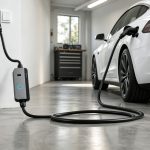
Level 1 charging is the most basic of all electric charging types. It uses a standard 120-volt AC household outlet — the same receptacle you use for a lamp or phone charger — and requires zero electrical modifications.
- Voltage: 120V AC
- Power output: 1–1.8 kW
- Range added per hour: 3–5 miles
- Full charge time (BEV): 40–50+ hours
Among the different types of ev chargers, Level 1 works best for plug-in hybrid electric vehicles (PHEVs) with smaller battery packs, or for BEV drivers who cover fewer than 30 miles daily and charge overnight. It is also the default option for EV owners in apartments, rental properties, or older homes where dedicated circuits are not feasible.
The tradeoff is speed. Charging a 75 kWh battery from empty on Level 1 takes more than two full days, making it impractical as a primary solution for most full-electric vehicle owners. When comparing electric car charger types, Level 1 is the slowest but cheapest to deploy.
Level 2 Chargers
Level 2 charging is the most widely deployed of all electric charging types for both residential and commercial settings. It uses a 240-volt circuit — similar to what a clothes dryer requires — and delivers substantially more power than Level 1.
- Voltage: 208–240V AC
- Power output: 7–19 kW (residential units typically 7–11 kW)
- Range added per hour: 10–40 miles
- Full charge time (BEV): 4–10 hours
According to the U.S. Department of Energy’s Alternative Fuels Data Center, nearly 80% of public EV charging ports in the United States were Level 2 units — a testament to their versatility and cost-effectiveness among the different types of electric car chargers.
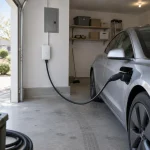
Level 2 chargers dominate home wall-box installations, workplace charging programs, and destination charging at hotels, retail centers, and restaurants. They offer the best balance of charging speed, equipment cost, and infrastructure requirements. Most residential units use the SAE J1772 connector in North America or the Type 2 connector in Europe, and installation typically requires a dedicated 40–80 amp circuit. For most EV owners evaluating electric car charger types, Level 2 represents the optimal home charging solution.
DC Fast Chargers
DC Fast Chargers (DCFC), often referred to as Level 3 chargers, represent the highest-performance tier among electric charging types. Rather than delivering AC power that the vehicle must convert internally, DCFC units convert AC to DC externally and feed high-power direct current straight into the battery pack.
- Voltage: 400–1,000V DC
- Power output: 50–350 kW (newer units exceed 400 kW)
- Charge time (10–80%): 20–60 minutes
DC fast charging is purpose-built for public corridors, highway rest areas, and commercial fleet operations where rapid turnaround is essential. Among the types of electric vehicle chargers, DCFC equipment is significantly more expensive than Level 2 — both in hardware and installation — and demands substantial grid capacity, specialized cooling, and often transformer upgrades.
Not every EV supports DCFC. Most PHEVs lack DC fast-charging capability, and among BEVs, the maximum accepted rate varies widely. A vehicle rated for 150 kW at a 350 kW station will only draw what its battery management system permits. The U.S. Department of Transportation notes that DCFC can charge a BEV to 80 percent in as little as 20 minutes under optimal conditions.
Electric Car Charger Types Explained
Beyond charging levels, electric car charger types are further defined by their physical connectors and communication protocols. These connector standards determine which vehicles can physically plug into which chargers — and they vary significantly by geography.
Type 1 Charging
The Type 1 connector, standardized under SAE J1772 in North America, is a five-pin AC charging plug designed for single-phase power delivery. It was among the earliest standardized EV connectors and remains prevalent across North America and Japan.
- Standard: SAE J1772 (North America)
- Power: Up to 7.2 kW (single-phase, 240V)
- Pins: 5 (two power, one ground, two communication/proximity)
- Primary regions: North America, Japan
Type 1 connectors appear on most AC charging equipment deployed in North America for residential and commercial Level 2 installations. They feature automatic locking during charging and a proximity detection pin that prevents the vehicle from driving away while plugged in. Among the different types of ev chargers, Type 1 is increasingly being supplemented by the Combined Charging System (CCS), which adds DC fast-charging pins below the existing Type 1 AC connector to create a single combined inlet.
Type 2 Electric Vehicle Charging
The Type 2 connector, formally designated IEC 62196-2 and commonly called the Mennekes connector, is the standard AC charging plug across Europe, Australia, and many markets outside North America. Type 2 electric vehicle charging is the dominant standard in these regions.
- Standard: IEC 62196-2
- Power: 3.7–22 kW (single-phase up to 7 kW; three-phase up to 22 kW)
- Pins: 7 (three power, one neutral, one ground, two communication)
- Primary regions: Europe, Australia, parts of Asia and Africa
The European Commission designated Type 2 as the official AC charging plug for the European Union in January 2013. This standardization ensures that any Type 2-equipped EV can charge at any Type 2 public point across the EU without adapters.
Type 2 electric vehicle charging supports both single-phase and three-phase AC power, giving it a significantly higher power ceiling than Type 1. Most European home wall-boxes deliver 7–11 kW on single-phase, while commercial and workplace chargers can reach 22 kW on three-phase supply. Like Type 1, the Type 2 connector also serves as the AC foundation for the CCS2 DC fast-charging standard, which adds two high-current DC pins below the AC socket.
CCS and CHAdeMO Connectors
For DC fast charging, two connector families dominate the global landscape — the most important electric charging types for highway and commercial applications.
CCS (Combined Charging System) combines an AC connector (Type 1 or Type 2, depending on region) with two additional DC pins, creating a single inlet that handles both AC and DC charging through one port. CCS is the leading standard among the types of electric vehicle chargers for DC fast charging worldwide.
- CCS1 (based on Type 1): Primary DC standard in North America. Max power up to 350 kW.
- CCS2 (based on Type 2): Dominant DC standard in Europe and expanding globally. Max power up to 350 kW, with newer deployments targeting 500 kW.
CCS has become the default DC fast-charging standard for most new EV models worldwide. Major networks — including Electrify America, Ionity, and Fastned — have standardized on CCS. When comparing different types of ev chargers for DC applications, CCS offers the broadest vehicle compatibility.
CHAdeMO, developed in Japan by TEPCO and the CHAdeMO Association, was one of the first DC fast-charging standards and remains in active use. Among electric car charger types, CHAdeMO is notable for its bidirectional capabilities.
- Standard: JEVS G105
- Power: Up to 400 kW (CHAdeMO 2.0)
- Unique feature: Bidirectional charging (V2G/V2H) — the vehicle can feed power back to the grid or a home
CHAdeMO-equipped vehicles like the Nissan LEAF require a separate AC charging port since CHAdeMO is a DC-only connector. This dual-port design adds complexity compared to CCS’s single combined inlet. While CHAdeMO infrastructure is gradually declining in favor of CCS in many markets, it remains relevant in Japan and for owners of existing CHAdeMO-compatible vehicles.
Pros and Cons of Different Types of EV Chargers
Evaluating the different types of ev chargers requires weighing speed, cost, compatibility, and infrastructure demands. No single option among electric charging types is universally ideal — each excels in specific scenarios.
Charging Speed
Speed is the most visible differentiator among ev charger types. The table below summarizes key performance metrics:
| Charging Level | Voltage | Power Output | Range per Hour | BEV Time to 80% |
|---|---|---|---|---|
| Level 1 | 120V AC | 1–1.8 kW | 3–5 miles | 40–50+ hours |
| Level 2 | 208–240V AC | 7–19 kW | 10–40 miles | 4–10 hours |
| DC Fast Charging | 400–1,000V DC | 50–350 kW | Up to 200+ miles in 30 min | 20–60 minutes |
Data adapted from the U.S. Department of Transportation EV Charging Toolkit.
The pattern is straightforward: faster charging demands more expensive equipment, higher-capacity electrical infrastructure, and greater grid coordination. Level 1 is inexpensive to deploy but impractically slow for most BEV owners. DC fast charging delivers dramatic speed but at a cost justified primarily for commercial or highway applications.
Compatibility with Vehicles
Not every charger works with every EV. Compatibility among the different types of ev chargers depends on two factors: the charging level the vehicle supports and the physical connector it uses.
- All EVs in North America support Level 1 and Level 2 via the J1772/Type 1 connector
- Most BEVs also support DC fast charging via CCS1 (North America) or CCS2 (Europe)
- PHEVs typically lack DC fast-charging capability and rely on Level 1 or Level 2 only
- Japanese-market vehicles (Nissan LEAF, Mitsubishi) often use CHAdeMO for DC fast charging
- Tesla vehicles use the proprietary NACS connector in North America, with CCS adapters increasingly available
Before investing in a home charger or planning a commercial installation, always verify that the connector type and charging level match your current and planned vehicles. The different types of electric car chargers are not universally interchangeable, and adapter solutions may not cover every scenario.
How to Choose the Right Charger for Your Needs
With so many electric charging types and connector standards in the market, selecting the right charger comes down to matching your specific requirements against each option’s strengths.
Factors to Consider
Use this decision framework to narrow your options among electric charging types:
- Vehicle compatibility: Confirm which connector standard and charging level your EV supports. Check the owner’s manual or inspect the vehicle’s charging port directly.
- Daily driving distance: Drivers covering fewer than 40 miles per day may find Level 1 sufficient. Longer commutes or larger battery packs call for Level 2 as a minimum.
- Electrical infrastructure: Level 2 requires a dedicated 240V circuit. DC fast charging demands three-phase power and significant grid capacity — typically feasible only at commercial sites.
- Installation location: Home garages favor Level 2 wall-boxes. Commercial sites with high vehicle throughput need DC fast chargers. Workplace and destination locations typically deploy Level 2 units.
- Budget: Level 1 equipment costs virtually nothing. Level 2 home chargers range from $300–$700 plus installation. DC fast chargers start at $10,000–$50,000+ for commercial-grade hardware.
- Future-proofing: Consider whether the charger must accommodate additional vehicles or newer models with higher charging acceptance rates over its expected lifespan.
Future of EV Charging Technologies
The EV charging landscape is evolving rapidly. Several trends are reshaping infrastructure planning:
- Higher power levels: DC fast chargers are pushing beyond 350 kW, with manufacturers targeting 500 kW and above. The Megawatt Charging System (MCS) is under development for heavy-duty vehicles, targeting up to 3.75 MW.
- NACS consolidation: Tesla’s North American Charging Standard is being adopted by Ford, GM, Rivian, Volvo, and others, potentially unifying the North American connector landscape.
- Bidirectional charging: Standards like CHAdeMO and emerging CCS bidirectional protocols allow EVs to serve as mobile energy storage, feeding power back to homes or the grid during peak demand.
- Smart charging: Networked chargers with dynamic load balancing, solar integration, and time-of-use optimization are becoming standard, reducing grid strain and electricity costs.
- Wireless charging: Inductive charging pads are under development for both stationary and dynamic (in-road) applications, though commercial deployment remains limited.
Conclusion
Understanding the full spectrum of electric charging types — from basic Level 1 household charging to high-power DC fast charging — is essential for every EV owner, fleet operator, and infrastructure planner. Each charging level and connector standard serves a distinct purpose, and the optimal choice depends on your vehicle, driving habits, electrical capacity, and budget.
For residential users, Level 2 charging with the appropriate regional connector offers the best balance of convenience and cost. For commercial and highway applications, DC fast chargers are indispensable. As charging standards converge and power levels climb, investing in flexible, forward-compatible equipment will deliver long-term value across the evolving landscape of electric charging types.
If you are evaluating charging solutions for your home, business, or fleet, exploring the full range of AC and DC EV charging products — including Level 2 smart chargers, DC fast chargers, portable units, and integrated energy storage solutions — can help you find the right configuration for your electric mobility goals.