

What Is Mode 2 EV Charging?
Every portable EV charging station on the market today operates on a principle defined by the International Electrotechnical Commission over a decade ago. That principle is Mode 2 charging — the international standard that makes it safe to plug an electric vehicle into an ordinary household socket and draw power without a dedicated wallbox.
According to IEC 61851-1:2017, the global standard for electric vehicle conductive charging systems, Mode 2 charging connects an EV to a standard AC socket outlet while using an in-cable control and protection device (IC-CPD) to manage safety. Unlike Mode 1 — which is essentially a bare cable with no protection and is banned in most countries — Mode 2 builds critical safeguards directly into the charging cable itself.
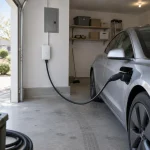
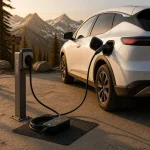
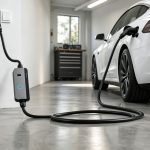
This is the technology inside every portable charging station for electric cars sold today. Whether you call it an ev portable charging station, a portable EV charger for car use, or simply a mobile charger, the underlying architecture is the same: a mains plug, a control box, and a vehicle connector, all working together under Mode 2 rules. In short, a portable electric vehicle charging station is any device that delivers Mode 2 (or higher) charging from a standard socket with integrated safety.
The Core Component: IC-CPD (In-Cable Control and Protection Device)
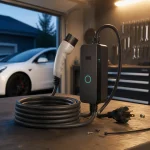
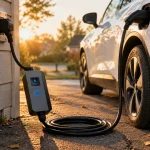
The IC-CPD is the brain and the shield of any portable EV charging station. Housed in a box along the cable — typically about the size of a large smartphone — this device handles both the intelligence and the safety functions that make portable ev charging viable on domestic circuits. Without it, a portable charging station for car use would be nothing more than a glorified extension cord.
What the IC-CPD Does
When you plug a portable ev charger for car charging into a wall socket, the IC-CPD performs several tasks simultaneously:
- Communication with the vehicle: It sends a control-pilot signal to the EV’s onboard charger, confirming that a safe connection exists and negotiating the maximum allowable current.
- Current limitation: It restricts the charging current to a level the household socket and wiring can handle — typically 10 A to 16 A, depending on the region and the specific portable ev charging station model.
- Fault detection: It continuously monitors for earth leakage, overcurrent, overvoltage, and undervoltage conditions, cutting power within milliseconds if something goes wrong.
- Temperature monitoring: Many modern IC-CPDs include thermal sensors at the plug end to detect overheating — a critical safeguard when charging from older or heavily loaded domestic outlets.
Key Protection Functions
The table below summarizes the protection layers a compliant IC-CPD provides, as defined under IEC 62752 — the standard specifically written for Mode 2 in-cable protection devices used in every ev portable charging station:
| Protection Function | What It Does | Why It Matters |
|---|---|---|
| Residual current detection (AC + DC) | Detects leakage currents as low as 6 mA DC and trips at 20–30 mA AC | Prevents electric shock if current finds an unintended path |
| Overcurrent protection | Limits current draw to the rated capacity (e.g., 10 A, 13 A, 16 A) | Protects household wiring from overheating |
| Overvoltage / undervoltage | Monitors supply voltage and disconnects if outside safe range | Guards the vehicle’s onboard charger from voltage spikes or sags |
| Temperature monitoring | Thermal sensor at the plug detects abnormal heat buildup | Prevents fire risk from loose or degraded socket contacts |
| Grounding verification | Confirms a valid earth connection before enabling charge | Ensures fault current has a safe path to ground |
| Automatic disconnect on fault | Cuts power within milliseconds of detecting any anomaly | Minimizes damage risk to vehicle, cable, and user |
Protection requirements per IEC 62752:2016 — In-cable control and protection device for Mode 2 charging of electric road vehicles.
Step-by-Step: How Mode 2 Charging Works
Understanding the charging sequence helps explain why a portable charging station for car use is far more sophisticated than a simple extension cord. Here is what happens from the moment you plug in a portable EV charging station:
- Physical connection: You plug the mains end into a standard household socket (Schuko, BS 1363, NEMA 5-15, etc.) and the vehicle end into the car’s charging inlet (Type 1, Type 2, or J1772, depending on region).
- Standby state: The IC-CPD powers up and runs a self-check. It verifies the supply voltage, confirms the grounding connection, and initializes the control-pilot circuit.
- Control-pilot handshake: The IC-CPD sends a PWM (pulse-width modulation) signal through the control-pilot wire to the vehicle. This signal tells the car how much current is available — for example, a 10 A limit on a 230 V circuit means the vehicle should draw no more than 2.3 kW.
- Vehicle acknowledgment: The EV’s onboard charger reads the signal, confirms it can accept that current level, and closes its internal contactor to begin drawing power.
- Active charging: Current flows from the grid, through the IC-CPD, through the cable, into the vehicle’s onboard charger, which converts AC to DC and feeds the battery. The IC-CPD continuously monitors all parameters throughout this phase.
- Completion or interruption: When the battery reaches its target state of charge, the vehicle opens its contactor, ending the current draw. The IC-CPD returns to standby. Alternatively, if a fault is detected at any point, the portable ev charger for car unit disconnects immediately.
This entire handshake happens in under a second. From the user’s perspective, it is as simple as plugging in a lamp — but behind the scenes, multiple safety layers are actively working to ensure safe portable ev charging at every moment.
Mode 2 vs. Mode 3 vs. Mode 1: A Quick Comparison
Not all EV charging modes are created equal. The table below shows how Mode 2 compares to its neighbors across the dimensions that matter most to buyers evaluating a portable electric vehicle charging station:
| Feature | Mode 1 | Mode 2 | Mode 3 |
|---|---|---|---|
| Power source | Standard socket | Standard socket | Dedicated EVSE / wallbox |
| Max current | Up to 16 A | Up to 32 A (typically 10–16 A) | Up to 63 A (typically 16–32 A) |
| Max power (single-phase) | ~3.7 kW | ~3.7–7.4 kW | ~7.4–22 kW |
| Built-in protection | None | IC-CPD (integrated in cable) | Full EVSE with RCD, contactor, communication |
| Portability | Very high (just a cable) | High (cable + control box) | Low to medium (fixed or semi-portable) |
| Installation required | None | None | Professional installation typically needed |
| Typical use case | Restricted / banned in most markets | Emergency, travel, occasional | Daily home charging, public stations |
| Relevant standard | IEC 61851-1 | IEC 61851-1 + IEC 62752 | IEC 61851-1 + IEC 62955 |
Charging mode framework based on IEC 61851-1:2017 definitions.
The key takeaway: Mode 2 is the only standard that combines true portability with integrated safety. Mode 3 is faster but requires fixed infrastructure. Mode 1 offers neither safety nor regulatory compliance. For drivers who need flexibility — road trips, visiting relatives, emergency top-ups — portable ev charging under Mode 2 is the practical choice, and a well-built portable charging station for electric cars makes that choice even more compelling.
Charging Speed and Power Output of Mode 2
One of the most common questions about a portable EV charging station is how fast it actually charges. The answer depends on voltage, current rating, and the vehicle’s onboard charger capacity.
| Configuration | Voltage | Current | Power | Approx. Range Added per Hour* |
|---|---|---|---|---|
| North America Level 1 (120 V / 12 A) | 120 V | 12 A | 1.4 kW | 4–5 miles (6–8 km) |
| North America Level 1 (120 V / 16 A) | 120 V | 16 A | 1.9 kW | 6–7 miles (10–11 km) |
| Europe (230 V / 10 A) | 230 V | 10 A | 2.3 kW | 8–10 miles (13–16 km) |
| Europe (230 V / 13 A) | 230 V | 13 A | 3.0 kW | 10–13 miles (16–21 km) |
| Europe (230 V / 16 A) | 230 V | 16 A | 3.7 kW | 13–16 miles (21–26 km) |
*Range estimates vary by vehicle efficiency. Typical consumption assumed at 15–20 kWh/100 km.
At 3.7 kW — the most common Mode 2 output in 230 V markets — a 60 kWh battery charges from 0 to 100% in roughly 16 hours. That is not fast by DC public-charging standards, but it is more than enough for overnight top-ups or emergency replenishment. Most PHEV owners with smaller batteries (10–15 kWh) can fully recharge in 3–5 hours, making a portable ev charger for car a genuinely practical daily tool. For fleet managers, deploying an ev portable charging station as a backup asset means vehicles never sit idle waiting for a fixed charger to free up.
Where a Portable EV Charging Station Is Most Useful
A portable ev charging setup fills gaps that fixed wallboxes and public DC fast chargers cannot cover. The most common scenarios include:
- Emergency roadside charging: A flat battery far from the nearest public charger. A portable charging station for car use connected to any accessible household socket can provide enough range to reach a proper charging point.
- Travel and road trips: Staying at hotels, vacation rentals, or rural locations without EV infrastructure. A portable ev charger for car fits in the trunk and works with local sockets in most countries.
- Workplace and fleet flexibility: Companies that rotate vehicles between locations or lack dedicated parking infrastructure can deploy a portable charging station for electric cars on demand, without construction or permits.
- Multi-property owners: Drivers who split time between two homes, neither of which has a wallbox, can carry a single ev portable charging station between locations.
- Pre-infrastructure markets: In regions where public charging networks are still developing, a portable electric vehicle charging station provides essential charging capability from day one of EV ownership.
- Rental and shared mobility: Car-sharing operators and rental fleets use portable EV charger for car units as backup charging assets, reducing downtime when dedicated chargers are occupied or out of service.
How to Choose the Right Portable EV Charging Station
Not every portable EV charging station on the market offers the same level of safety or performance. Here are the criteria that matter most for B2B buyers and fleet specifiers evaluating a portable electric vehicle charging station:
- IEC certification: Ensure the unit complies with IEC 62752 for IC-CPD safety. In Europe, this is mandatory for any ev portable charging station sold. In North America, look for ETL or UL listing.
- Current rating: Match the charger’s rated current to your typical socket capacity. A 16 A portable EV charging station delivers faster charging but requires a socket and wiring rated for that load.
- Connector compatibility: Type 2 for Europe, J1772 or NACS for North America, GB/T for China. Some portable ev charger for car models offer interchangeable connectors for multi-market use.
- Cable length: Standard lengths range from 3 to 7 meters. Longer cables add flexibility but increase weight and voltage drop.
- IP rating: For outdoor use, the IC-CPD box should be at least IP66-rated (dust-tight and protected against powerful water jets). The connectors should be at least IP55 when mated.
- Temperature monitoring: Units with plug-end thermal sensors offer an extra layer of protection, especially when charging from older or shared sockets.
- Adjustable current: Some advanced portable EV charging station models let you dial the current up or down (e.g., 10 A / 13 A / 16 A), giving flexibility across different socket types and regional standards.
- Weight and packaging: A good portable charging station for electric cars should come with a carry bag or reel, and weigh under 5 kg for practical trunk storage.
Conclusion
Mode 2 charging is the engineering foundation that makes portable EV charging safe, practical, and globally standardized. The IC-CPD at the heart of every portable EV charging station transforms a simple household socket into a legitimate charging point — complete with fault detection, current negotiation, and automatic disconnect capabilities that rival fixed installations.
For EV owners who value flexibility, a high-quality portable charging station for car use is not just an emergency backup — it is a genuine charging solution that covers scenarios no wallbox can reach. Whether you are evaluating options for personal use, fleet deployment, or resale in your market, understanding how Mode 2 works inside the device gives you the technical confidence to make the right specification choices for your portable electric vehicle charging station.
For teams ready to explore certified portable EV charging solutions, our portable EV charger range covers the power levels, connector types, and safety standards discussed in this guide.