

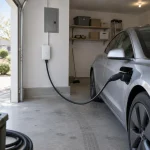
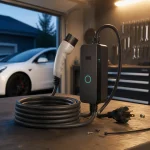
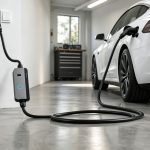
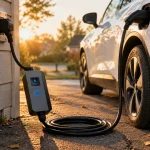
What Is a Level 2 Portable EV Charger?
As electric vehicle adoption accelerates globally — the International Energy Agency notes that charging infrastructure must expand significantly to keep pace with rising EV sales — more drivers are looking beyond the basic charging cord that ships with their car. A Level 2 portable EV charger offers a practical middle ground: faster charging than a standard 120V wall outlet, without the permanence and cost of a hardwired installation.
But with amperage ratings ranging from 16A to 48A, multiple plug types, and varying safety certifications, choosing the right portable ev charger requires understanding a handful of key parameters. This guide breaks down every specification that matters so you can make an informed purchase decision in 2026 — whether you’re outfitting a single-family garage or managing a fleet of electric cars portable chargers need to serve.
What this guide covers:
- Core Electrical Parameters
- Connector Standards and Vehicle Compatibility
- Safety Certifications and Protection Features
- Build Quality: IP Rating, Cable, and Durability
- Portable vs. Hardwired Level 2
- How to Match Charger Parameters to Your EV
- Final Checklist for Buying in 2026
Core Electrical Parameters You Need to Understand
Voltage and Amperage: The Power Equation
Every portable level 2 ev charger operates at 240 volts (or 208V in some commercial settings) in North America. The variable that differentiates one unit from another is amperage — the flow rate of electrical current.
The relationship is straightforward: Power (kW) = Voltage (V) × Amperage (A) ÷ 1,000
| Amperage | Voltage | Power Output | Typical Range Added per Hour |
|---|---|---|---|
| 16A | 240V | 3.8 kW | 12–16 miles |
| 24A | 240V | 5.76 kW | 18–24 miles |
| 32A | 240V | 7.68 kW | 25–32 miles |
| 40A | 240V | 9.6 kW | 30–40 miles |
| 48A | 240V | 11.52 kW | 35–50 miles |
Most modern EVs accept at least 32A on Level 2, and many accept 40A or 48A. Always verify your vehicle’s onboard charger capacity before purchasing — buying a portable electric vehicle car charger rated at 48A for a car that only accepts 32A wastes money and delivers no speed benefit.
Power Output (kW) and Charging Speed
Power output directly determines how quickly your battery replenishes. For context, charging a 60 kWh battery from 20% to 80% — a common daily charging window — takes roughly:
- 3.8 kW (16A): approximately 8–10 hours
- 7.68 kW (32A): approximately 4–5 hours
- 9.6 kW (40A): approximately 3–4 hours
For overnight charging at home, even a 16A unit can fully replenish most EV batteries in 8–10 hours. But if you drive more than 40 miles daily or need faster turnaround between trips, stepping up to a 32A or 40A portable level 2 ev charger makes a meaningful difference in daily convenience.
Dual-Voltage Capability: 120V and 240V in One Unit
Some premium portable ev charger level 2 models offer dual-voltage operation — they can plug into a standard 120V household outlet for Level 1 trickle charging or connect to a 240V outlet for full Level 2 speeds. This flexibility is valuable for drivers who:
- Charge at home on a 240V outlet overnight
- Top up at a relative’s house with only a standard 120V outlet available
- Need emergency charging at a campground or workplace with limited infrastructure
A dual-voltage portable ev charger eliminates the need to carry two separate units, making it a versatile choice for frequent travelers and multi-location users.
Plug and Outlet Compatibility
A level 2 ev charger portable unit must match the outlet you plan to use. The most common NEMA outlet types for EV charging in North America include:
| NEMA Type | Configuration | Max Continuous Amps | Common Use Case |
|---|---|---|---|
| 14-50 | 4-prong, 240V/50A | 40A | RV outlets, modern homes |
| 14-30 | 4-prong, 240V/30A | 24A | Older dryer outlets |
| 6-50 | 3-prong, 240V/50A | 40A | Workshops, garages |
| 10-30 | 3-prong, 125/250V/30A | 24A | Legacy dryer outlets |
| 6-20 | 3-prong, 240V/20A | 16A | Smaller workshop circuits |
Some portable ev charger level 2 models offer interchangeable plugs or adapters, letting you switch between outlet types without buying multiple units. This is particularly valuable for drivers who charge at multiple locations — a NEMA 14-50 adapter for the garage and a NEMA 14-30 adapter for a parent’s dryer outlet, for example.
Connector Standards and Vehicle Compatibility
The connector on the vehicle end must match your EV’s inlet. In North America, the dominant standards are:
- SAE J1772 (Type 1) — the standard AC charging connector for nearly all non-Tesla EVs sold in the US and Japan. Supports Level 1 and Level 2 charging.
- NACS (Tesla Connector) — used by Tesla vehicles and increasingly adopted by other manufacturers starting in 2025. Many portable chargers now offer NACS variants or adapter compatibility.
- Type 2 (Mennekes) — standard in Europe for AC charging. Relevant if you’re sourcing electric cars portable chargers for international markets.
Before purchasing, confirm which connector your vehicle uses. A level 2 evse portable charger with the wrong connector is useless without an adapter — and adapters add cost, bulk, and another point of potential failure.
Safety Certifications and Protection Features
UL/ETL Listing and Code Compliance
Safety certification is non-negotiable for any electrical device that connects to your vehicle and your home’s power supply. In North America, look for:
- UL 2594 — the primary standard for EV supply equipment, covering electrical safety, fire resistance, and mechanical durability.
- UL 2251 — covers connectors and coupling mating integrity.
- ETL listing — an alternative Nationally Recognized Testing Laboratory (NRTL) certification equivalent to UL.
A certified portable level 2 ev charger has been independently tested to ensure it won’t overheat, short-circuit, or create a fire hazard under sustained load. Never purchase an uncertified unit — the savings aren’t worth the risk to your vehicle, your home, or your family.
GFCI, RCD, and Thermal Protection
Beyond certification, quality portable ev charger units include built-in protection features that guard against common electrical hazards:
- GFCI (Ground Fault Circuit Interrupter) — detects current leakage and cuts power instantly to prevent electric shock, critical for outdoor charging in wet conditions.
- RCD (Residual Current Device) — similar to GFCI, common in European-standard units. Some chargers include Type A or Type A+6mA DC RCD protection for comprehensive fault coverage.
- Thermal overload protection — monitors internal temperature and reduces power or shuts down if overheating is detected.
- Over-current and over-voltage protection — prevents damage from power surges, incorrect voltage, or circuit faults.
These features are especially critical for outdoor charging in rain, snow, or extreme heat — conditions a portable electric vehicle car charger will inevitably face.
Build Quality: IP Rating, Cable, and Durability
A portable electric vehicle car charger travels in your trunk, gets dragged across garage floors, and sits exposed to weather. Build quality directly impacts longevity and reliability.
- IP Rating — look for at least IP54 (protected against dust ingress and water splashes from any direction). Higher ratings like IP66 offer full dust-tight protection and resistance to powerful water jets.
- Cable quality — heavy-duty, flexible cables rated for outdoor use. Typical lengths range from 18 to 25 feet. Thicker gauge wires (lower AWG number) handle higher amperage with less heat buildup.
- Operating temperature range — quality units operate safely from −22°F to 122°F (−30°C to 50°C), covering most climates worldwide.
- Enclosure material — robust, UV-resistant housing that withstands drops, abrasion, and prolonged sun exposure without cracking or fading.
Portable vs. Hardwired Level 2: Which Fits Your Situation?
| Factor | Portable Level 2 Charger | Hardwired Wall-Mount Unit |
|---|---|---|
| Installation | None — plug and play | Licensed electrician required |
| Upfront cost | $200–$600 | $400–$1,200 + $500–$2,000 installation |
| Max power | Up to 40A (9.6 kW) typical | Up to 80A (19.2 kW) |
| Mobility | Store in trunk, take anywhere | Fixed location |
| Ideal for | Renters, multi-location users, travelers | Homeowners with dedicated parking |
| Outdoor use | Yes (if IP-rated) | Yes (if rated for it) |
If you own your home and have a dedicated parking spot, a hardwired unit delivers maximum power. But if you rent, move frequently, or charge at multiple properties, a portable ev charger is the smarter investment — you take it with you wherever you go, and the total cost of ownership stays lower since there’s no installation expense.
How to Match Charger Parameters to Your EV
Not every EV benefits from the highest-amperage level 2 evse portable charger. Your vehicle’s onboard charger determines the maximum speed it can accept:
- Compact EVs (e.g., Nissan Leaf, Chevy Bolt) often accept up to 6.6 kW or 7.2 kW. A 32A portable level 2 ev charger is sufficient and cost-effective.
- Mid-size and large EVs (e.g., Ford F-150 Lightning, Rivian R1T) can accept 11.5 kW or higher. A 40A or 48A unit unlocks their full charging potential and reduces downtime between trips.
- Plug-in hybrids (PHEVs) typically accept 3.3–6.6 kW. A 16A or 24A portable ev charger level 2 unit is adequate — spending more on amperage you can’t use provides no benefit.
Check your vehicle’s owner manual or the manufacturer’s charging specifications before selecting amperage. Matching your portable ev charger to your vehicle’s actual acceptance rate avoids overspending and ensures optimal charging performance.
Final Checklist for Buying a Level 2 Portable EV Charger in 2026
When evaluating options, run through this checklist to ensure you select a unit that meets your needs:
- Amperage: Does it match your EV’s onboard charger capacity?
- Plug type: Does it match your available outlet (NEMA 14-50, 14-30, etc.)?
- Connector: J1772 or NACS — correct for your vehicle?
- Certification: UL 2594 or ETL listed?
- Safety features: GFCI/RCD, thermal protection, over-current protection?
- IP rating: At least IP54 for outdoor use?
- Cable length: Long enough to reach from outlet to vehicle?
- Warranty: At least 1–3 years from a reputable manufacturer?
For drivers ready to explore a reliable option, the ES-P01 portable EV charger from EV Taurus Power offers 16A/32A selectable output, IP54 weatherproofing, and built-in RCD protection in a compact, travel-friendly form factor — a solid example of what a well-specified level 2 evse portable charger should deliver in 2026.