

What Are AC EV Chargers and How Do They Work?
AC EV chargers supply alternating current from the electrical grid to an electric vehicle. The vehicle’s onboard charger then converts that AC power into direct current (DC) to store in the battery. This architecture keeps the charging hardware relatively simple and affordable compared to DC fast-charging stations, which house large power-conversion modules on-site.
Most ac charging for ev applications operates at 230 V single-phase or 400 V three-phase, delivering between 3.7 kW and 22 kW depending on the unit and local electrical standards. A typical 7 kW Electric Vehicle AC Charger can add roughly 30–40 km of range per hour of charging — enough to fully replenish a daily commute overnight.
The simplicity of this design is its strength. Because the heavy power electronics sit inside the car rather than in the charging unit itself, an ac charger for electric vehicle installation requires less equipment, lower electrical capacity, and significantly less upfront investment than a DC fast-charging setup. That cost advantage is why AC EV chargers account for the vast majority of public charging points worldwide.
AC vs DC EV Charging: A Quick Comparison
Understanding where an ev ac charger fits requires a clear picture of how it differs from DC fast charging. The table below summarizes the key distinctions that matter most to project planners and buyers.
| Parameter | AC Level 2 Charging | DC Fast Charging |
|---|---|---|
| Power output | 3.7 – 22 kW | 50 – 350 kW |
| Full charge time (60 kWh battery) | 3 – 16 hours | 20 – 60 minutes |
| Range added per hour | 15 – 90 km | 200 – 500+ km |
| Equipment cost per port | $3,000 – $15,000 | $80,000 – $250,000+ |
| Electrical infrastructure | Moderate | Heavy (transformer, trenching) |
| Best-fit scenarios | Home, workplace, destination | Highway, fleet depot |
| Grid-to-battery efficiency | 85 – 94 % | 90 – 95 % |
The efficiency gap between AC and DC comes from the AC-to-DC conversion step. During ac charging for ev, the vehicle’s onboard charger performs this conversion, and some energy is lost as heat. DC fast chargers handle the conversion externally, which reduces — but does not eliminate — those losses. For overnight and workplace scenarios where vehicles sit for hours, the slightly lower efficiency of ac charging for ev is a worthwhile trade-off against dramatically lower hardware and installation costs.
According to the IEA Global EV Outlook 2025, slow chargers rated at 22 kW or below remain the backbone of public charging infrastructure. In Europe, 85 % of urban public charging points fall into this category, reflecting the practical reality that most EV charging sessions happen where vehicles are already parked for extended periods.
AC EV Charger Power Levels and Connector Standards
Power Output Ranges
AC EV charger equipment spans three widely recognized tiers:
| Level | Voltage | Power Range | Typical Use |
|---|---|---|---|
| Level 1 | 120 V (North America) | 1.3 – 2.4 kW | Emergency trickle charging |
| Level 2 | 230 – 400 V | 3.7 – 22 kW | Home, workplace, public parking |
| Level 2 (high-power) | 400 V three-phase | 11 – 22 kW | Commercial and fleet applications |
For most commercial and residential projects, a vehicle ac charger in the 7 – 22 kW range offers the best balance of charging speed, electrical requirements, and cost. Units at the lower end (3.7 – 7 kW) suit single-vehicle home installations, while 11 – 22 kW three-phase units serve workplaces and multi-port deployments where faster turnaround matters.
Connector Standards by Region
Choosing the right connector is critical for any ac charging station project that serves multiple vehicle brands:
- Type 1 (SAE J1772): Standard in North America and Japan for AC charging. Single-phase, up to 19.2 kW.
- Type 2 (IEC 62196 / Mennekes): Dominant across Europe, the Middle East, and most of Asia. Supports single- and three-phase AC up to 22 kW.
- GB/T AC: The Chinese national standard for AC charging, used across mainland China.
- NACS: Originally developed by Tesla, now adopted by multiple automakers in North America for both AC and DC.
A well-specified ac charging station deployment should match the connector standard to the local vehicle fleet. For international or mixed-fleet deployments, some manufacturers offer swappable cable modules or dual-socket configurations on a single ev ac charger unit.
Key Application Scenarios for AC Charging
Residential and Home Charging
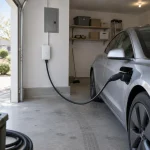
Home charging accounts for the largest share of EV charging sessions globally. A wall-mounted 7 – 11 kW Electric Vehicle AC Charger can fully recharge most EV batteries overnight. Key considerations for residential ac charging for ev include:
- Single-phase or three-phase supply availability
- Smart scheduling to take advantage of off-peak electricity tariffs
- Integration with rooftop solar PV systems for renewable self-consumption
- Load management to avoid tripping the household main breaker
Workplace and Commercial Parking
Employees typically park for 6 – 10 hours, making workplace charging an ideal match for AC EV charger speeds. A 22 kW Electric Vehicle AC Charger can deliver a full charge in under three hours, meaning even a single shift covers most daily driving needs. Multi-port ac charging station installations with dynamic load balancing allow property managers to serve many vehicles without exceeding the building’s electrical capacity.
Hospitality, Retail, and Destination Charging
Hotels, shopping centers, and restaurants benefit from offering an ev ac charger as a customer amenity. Dwell times of 2 – 4 hours align well with 7 – 22 kW charging rates. Beyond customer retention, destination ac charging station deployments create a new revenue stream through per-kWh billing or session fees, and they position the property as forward-thinking in an increasingly EV-aware market.
How to Choose the Right AC Charger for Electric Vehicle Projects
Power Rating and Vehicle Compatibility
The most common mistake in vehicle ac charger selection is oversizing. A 22 kW AC EV charger will not charge a vehicle faster if the car’s onboard charger is limited to 7 kW. Always check the target vehicle fleet’s maximum AC acceptance rate before specifying power output. For mixed fleets, an 11 kW unit often represents the best compromise — fast enough for most vehicles, and compatible with single-phase supply in many regions.
Smart Features and Network Connectivity
Modern ac charging for ev deployments benefit enormously from networked management. Look for these capabilities:
- OCPP compliance: Ensures the charger can connect to any compatible backend platform for remote monitoring, firmware updates, and billing.
- Dynamic load balancing: Distributes available electrical capacity across multiple chargers in real time, preventing overloads.
- RFID and app-based authentication: Controls access and enables user-specific billing in commercial settings.
- Solar integration: Prioritizes self-generated renewable energy, reducing grid draw and operating costs.
- Payment processing: Supports credit card, QR code, or contactless payment for revenue-generating installations.
Durability, Certification, and Environment
An ac charger for electric vehicle must withstand the environment where it is installed. Key specifications to verify:
- IP rating: IP54 for indoor or sheltered installations; IP65 for outdoor exposure to rain and dust.
- Operating temperature: Typically −25 °C to +50 °C for most commercial units.
- Impact resistance: IK08 or IK10 rating for public-facing locations where the unit may be bumped by vehicles or carts.
- Safety certifications: CE (Europe), UL (North America), or equivalent local marks to ensure regulatory compliance.
Installation Costs and ROI Considerations
One of the strongest arguments for an ac charging station is its favorable cost profile. The table below provides typical installed cost ranges for commercial projects:
| Cost Component | AC Level 2 (per port) | DC Fast Charger (per port) |
|---|---|---|
| Equipment | $1,000 – $5,000 | $20,000 – $100,000+ |
| Electrical work and installation | $1,500 – $8,000 | $50,000 – $150,000+ |
| Total installed cost | $3,000 – $15,000 | $80,000 – $250,000+ |
These figures vary based on site conditions — distance from the electrical panel, trenching requirements, transformer upgrades, and local labor rates. However, the order-of-magnitude difference between AC and DC remains consistent: AC EV charger installations typically cost 5 – 10× less per port than DC fast-charging deployments.
For revenue-generating projects, return on investment depends on utilization rates, local electricity pricing, and the billing model. Workplace ac charging for ev installations often justify their cost through employee retention and sustainability reporting rather than direct charging revenue. Destination and retail chargers can generate meaningful income through per-kWh markups, especially in high-traffic locations.
Custom Full-Scene Solutions: Tailoring Your AC EV Chargers Deployment
Every project has unique requirements shaped by the site, the vehicle fleet, the electrical supply, and the business model. A successful deployment starts with matching the right Electric Vehicle AC Charger configuration to each scene:
| Scene | Recommended Power | Key Features | Typical Configuration |
|---|---|---|---|
| Residential | 7 – 11 kW | Smart scheduling, solar integration, compact design | Single wallbox unit |
| Workplace | 11 – 22 kW | Load management, OCPP, RFID access | Multi-port pedestal or wall-mount |
| Destination / Retail | 7 – 22 kW | Payment processing, branding, app control | Dual-socket pedestal with display |
| Fleet (light-duty) | 11 – 22 kW | Scheduled charging, energy management, fleet software API | Multi-unit cluster with central management |
| Multifamily housing | 7 – 11 kW | Load balancing, billing per user, compact form factor | Wall-mounted units in parking garage |
The most effective deployments combine these scene-specific configurations into a unified, manageable network. Whether you need a single wallbox for a residential project or a multi-port ac charging station system for a commercial parking structure, the key is selecting hardware that supports the power levels, connector standards, and smart features each scenario demands.
For teams planning a multi-site rollout or a mixed-use deployment, working with a manufacturer that offers a full range of ev ac charger models — from compact 3.5 kW home units to 22 kW commercial pedestals — simplifies procurement, ensures consistency across locations, and streamlines after-sales support. Explore a complete lineup of AC EV chargers designed for every scene to find the right fit for your project.
Conclusion
AC EV chargers remain the workhorse of electric vehicle charging infrastructure worldwide. Their lower cost, simpler installation, and natural fit for extended parking scenarios make them the right choice for homes, workplaces, destination venues, and light-duty fleet operations. As EV adoption accelerates — with the IEA reporting that more than 1.3 million public charging points were added globally in 2025 alone — the demand for reliable, smart, and customizable ac charging for ev solutions will only grow.
The key to a successful deployment is matching the hardware to the scene: the right power level, the right connector, the right smart features, and the right installation partner. With careful planning, an ac charger for electric vehicle project can deliver years of dependable service while supporting the broader transition to electric mobility. Whether you are deploying a single vehicle ac charger at home or building a networked ac charging station fleet across multiple sites, AC EV chargers offer the flexibility and cost-effectiveness that modern EV infrastructure demands.